EN



Why All Terrain Trekking Sandals Perform Stably Under Harsh Natural Conditions
All terrain trekking sandals can look simple, yet stable performance on a harsh trail comes from several components working together. A secure sandal is not defined by one deep tread pattern or one thick footbed. It has to keep the foot positioned, give the outsole a predictable contact pattern, and let the wearer respond to changes in ground level. For product teams and buyers evaluating trekking sandals, the useful starting point is the intended terrain: dry rock, loose gravel, wet paths, shallow crossings, packed dirt, or soft ground each place different demands on the design.
From an outdoor range-planning perspective, trekking sandals should be assessed as an activity system rather than as an open-toe version of a walking shoe. Stability depends on the relationship among the upper, footbed, midsole, outsole, and the wearer’s fit. That distinction matters because a sandal that feels secure on a level path may need a different specification for irregular surfaces or prolonged downhill walking.
Stability begins with a clear terrain brief
Before comparing trekking sandals, define what “harsh natural conditions” means for the target range. A dry, rocky day hike calls for dependable foot placement and abrasion-aware materials. Wet stone or a stream approach makes slip behavior and drainage more relevant. Loose soil and side slopes increase the importance of lateral control. Mud can fill shallow tread channels, while hot, dry ground can expose weaknesses in cushioning or strap comfort over time.
This is a practical shift from feature list to priority. Instead of asking whether trekking sandals have “good grip,” ask which surfaces the wearer is expected to cross, how long they will walk, whether they carry a load, and how often the route changes direction. The answers help a buyer rank non-negotiable requirements rather than treating every component as equally important.
Foot retention keeps the platform working
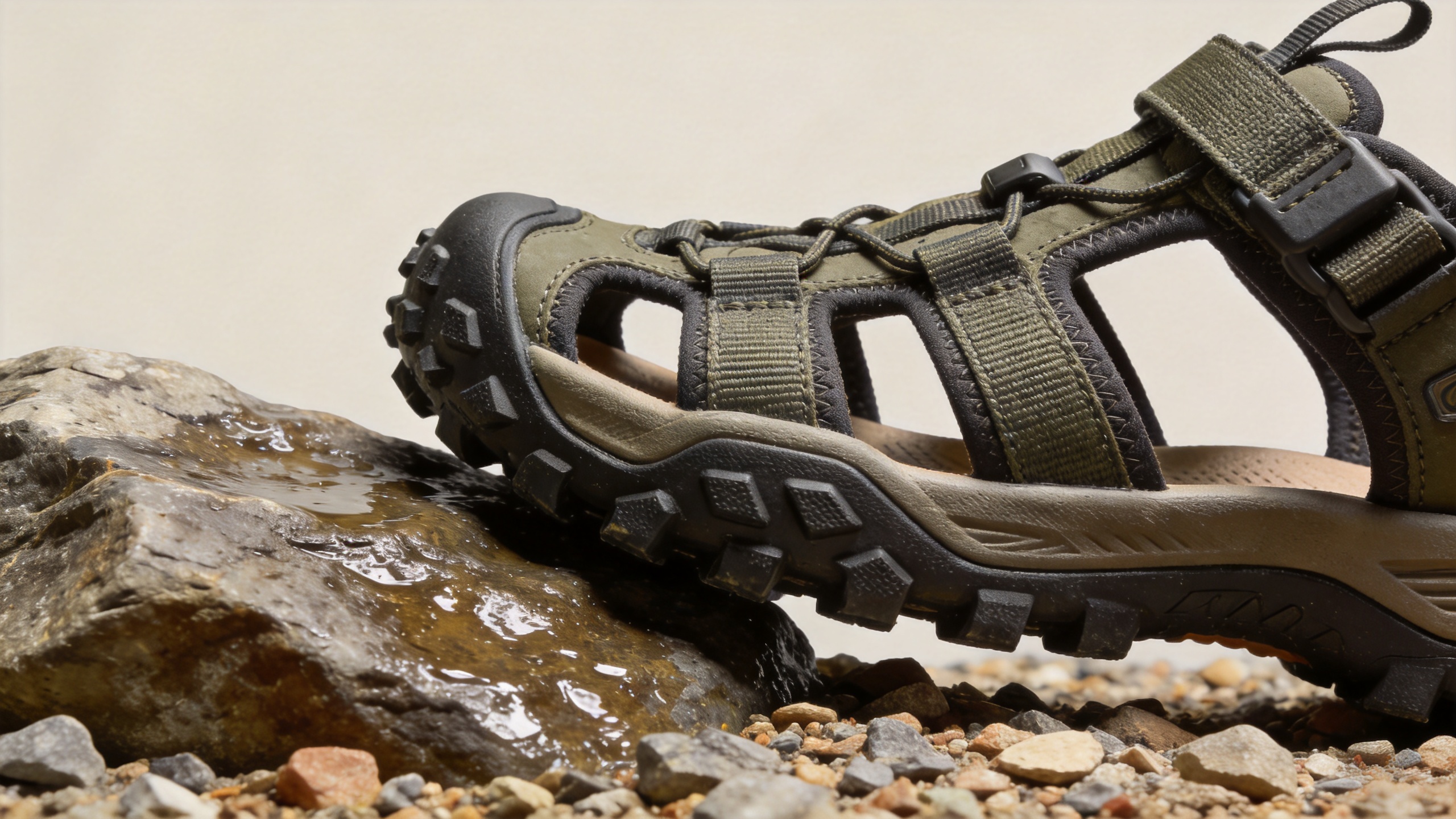
In trekking sandals, the outsole cannot do its job well if the foot slides across the footbed or lifts inside the strap system. A stable retention layout generally needs adjustable contact around the forefoot, instep, and heel so the wearer can tune fit within the design limits. The goal is not to promise the same fit for every foot shape. It is to create a reviewable system that reduces avoidable movement when the trail tilts, twists, or becomes uneven.
For trekking sandals, strap placement deserves as much attention as strap material. A supportive-looking strap can still leave the foot unstable if its anchor points do not help manage forward movement on descents or side-to-side movement on cambered ground. That said, strap layout is only one part of the fit conversation. Width, foot volume, walking duration, and sock-free use can all affect the final result. Sample reviews should therefore include uphill, downhill, and lateral-motion checks rather than a brief standing fit test.
Outsole design matches traction to surface conditions
The outsole is the most visible reason people associate trekking sandals with trail stability, but lug depth alone does not settle the question. Lug shape, spacing, orientation, rubber behavior, contact area, and the stiffness of the platform all influence how the sandal responds. On smoother rock, a broad and well-supported contact area may be more useful than an excessively aggressive pattern. On softer or muddier ground, spaced lugs can help avoid a tread that packs up immediately. A design brief should state which compromise is acceptable for the intended use.
Traction claims also need conditions attached to them. ASTM describes F2913 as a whole-footwear test method used on dry and contaminated flooring conditions; it is a useful reminder that slip behavior is not a single permanent attribute. A manufacturer or buyer should ask what surface, contamination condition, footwear size range, and test approach are relevant before treating a traction statement as proof. Trekking sandals intended for outdoor use should be reviewed on representative terrain as well as through any applicable controlled testing plan.
Platform support helps on uneven ground
Stable trekking sandals balance flexibility with enough structure to spread pressure and resist unwanted twisting. A very flexible build may feel natural on easy paths but can become less controlled when a foot lands across a small rock or an edge. At first, it may seem that a thicker sole answers the brief; more precisely, the right platform depends on the wearer, route, expected load, and desired ground feel.
Three questions help clarify the platform requirement:
- Does the footbed keep the foot centered during directional changes?
- Is the platform wide enough to support the intended foot placement without feeling cumbersome?
- Does the level of torsional resistance match the terrain and walking duration?
These are not universal pass-or-fail rules for trekking sandals. They are checkpoints for turning a broad “outdoor” request into a more precise development and testing brief.
Materials and construction need to survive repeated exposure
Harsh conditions rarely arrive one at a time. Trekking sandals may encounter moisture, dust, grit, ultraviolet exposure, repeated bending, and abrasion in the same trip. Construction choices should therefore be assessed as a combination: how the upper handles repeated adjustment, how contact points are reinforced, how the footbed behaves when wet, and how the outsole bonds to the rest of the platform. Material names alone do not prove durability or performance. They are topics for documented suitability review against the agreed use case.
For a brand, retailer, or importer, a useful specification conversation records the expected terrain, target wearer, strap-adjustment range, outsole concept, care expectations, and sample-test observations. This reduces the risk of using attractive visual references as if they were technical requirements. It also gives an OEM or ODM development discussion a clearer starting point.
How to evaluate trekking sandals before range approval
A useful evaluation follows the route itself. Confirm the activity and terrain brief, then review retention uphill, downhill, and across a slope. Inspect outsole contact and tread clearing on the surfaces that matter most, and assess the complete package after exposure to the conditions it is expected to handle. If a result is not documented, describe it as a question to verify rather than as a confirmed capability.
For trekking sandals, this approach helps distinguish stable design intent from a generic outdoor claim. It also makes trade-offs visible: more protection or structure can affect weight and flexibility; more adjustability may add components; a tread optimized for one surface may not behave identically on another. A considered range does not need to claim that one sandal conquers every condition. It needs to define the conditions it is designed to address and validate them in a way the buyer can review.
Final perspective
All terrain trekking sandals perform more predictably in harsh natural conditions when foot retention, outsole geometry, platform support, and construction choices are aligned with a real terrain brief. A practical next step is to turn “stable on trails” into specific questions about surfaces, movement, fit, and evidence. That gives product teams a clearer route from concept to sample review and gives wearers a more honest basis for choosing trekking sandals for the ground ahead.